Newcastle United
Newcastle United’s activity in the transfer market this summer has attracted criticism, especially given the team’s inconsistent performances so far this season. Much of the disruption stems from the situation involving Alexander Isak, whose push for a move to Liverpool F.C. forced head coach Eddie Howe to rethink his attacking setup after losing his leading striker.
In response, the club brought in Nick Woltemade and Yoane Wissa to help fill the gap. Neither, however, has yet matched the impact Isak made during his time at St James’ Park. Woltemade has arguably adapted better, though he tends to drop deeper to link play rather than operate as a pure goalscorer, while Wissa missed the first half of the campaign due to injury.
That has sparked ongoing debate about whether the two forwards can effectively play together or if Howe will need to return to the transfer market to add another attacking option. Achieving that, however, may prove difficult when looking at the type of fees other clubs are demanding.
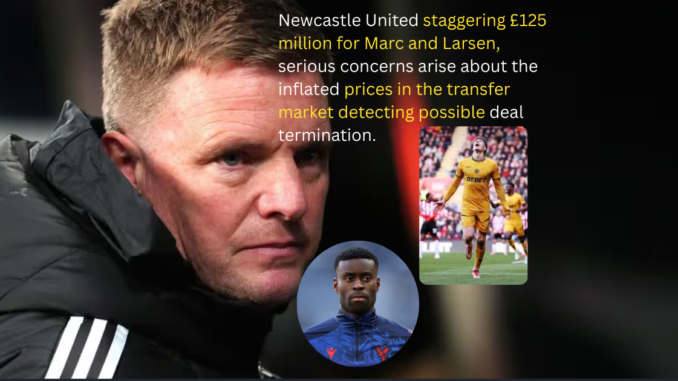
One example involves Wolverhampton Wanderers F.C. striker Jørgen Strand Larsen. Newcastle were reportedly quoted a hefty £60 million to sign the Norwegian before Wissa arrived on Tyneside. In hindsight, the Magpies likely made the right call by walking away from a deal at that price for a player who has not been particularly prolific.
Now Leeds United F.C. are said to be interested in the 25-year-old, who has managed just one goal and one assist in 19 Premier League appearances this season. Reports suggest Wolves have placed a price tag of around £40 million on him for Leeds, roughly £20 million less than what Newcastle were quoted only a few months earlier.
If that isn’t a clear sign of the so-called “Newcastle tax,” another example can be seen in the fee Manchester City F.C. are expected to pay Crystal Palace F.C. for Marc Guéhi. The England defender is reportedly close to a £20 million move to the Etihad, even though Newcastle were quoted an enormous £70 million for the same player in the summer of 2024.
Of course, context matters. Guéhi is now in the final months of his contract at Selhurst Park and could leave on a free transfer this summer, which weakens Palace’s negotiating position. Still, with both Liverpool and Manchester City interested, Newcastle would likely struggle to compete on wages anyway.
This situation highlights a broader frustration from the summer window. Newcastle aspire to operate among the elite clubs. They are competing on several fronts, including the UEFA Champions League, yet they remain some distance from the very top tier of English football.
That doesn’t mean they won’t get there, but it does expose ongoing challenges for the club and its ownership. Financial rules such as Premier League Profitability and Sustainability Rules have played a role in restricting spending, though those regulations are expected to change after this season. Even so, the difficulties in the market also highlight missed opportunities.
Targets like Hugo Ekitike and Benjamin Šeško ultimately chose moves to Liverpool and Manchester United F.C. instead of heading to Tyneside, despite Newcastle finishing higher than United and winning silverware. The expectation was that the club would build momentum this season, yet performances have not matched that ambition.
Recruitment has generally been a strength in recent years, but this summer’s business felt more reactive than carefully planned. Losing a world-class forward like Isak would disrupt any side, but the response has not fully convinced.
One signing that has raised questions is Anthony Elanga. Newcastle paid around £55 million, including add-ons, to bring the Swedish winger from Nottingham Forest F.C., and he has yet to justify that investment. Another arrival, Jacob Ramsey, has also struggled to make a significant impact since joining.
With financial regulations still affecting spending, Newcastle cannot afford expensive transfers that fail to deliver. Previous deals show how important smart recruitment has been. Players such as Sandro Tonali and Bruno Guimarães were signed for less and quickly became key figures in the starting lineup. Similarly, Anthony Gordon and Harvey Barnes justified their transfer fees far quicker than Elanga has so far.
Overall, the latest batch of signings has not delivered the same immediate impact as in previous seasons. To Newcastle’s credit, the club has often shown discipline by walking away from overpriced deals, as seen with Guéhi and Strand Larsen. Still, when fees climb that high, even a few missteps can become costly.
In hindsight, Newcastle appeared to be walking a tightrope last summer. They needed reinforcements but perhaps lacked the level of planning required to execute the right moves at the right time.
With Ross Wilson now in place, the club’s recruitment strategy could evolve. Going forward, Newcastle will likely need a more creative approach in the market if they want to navigate the challenges that come with the so-called “Newcastle United tax.”
Leave a Reply